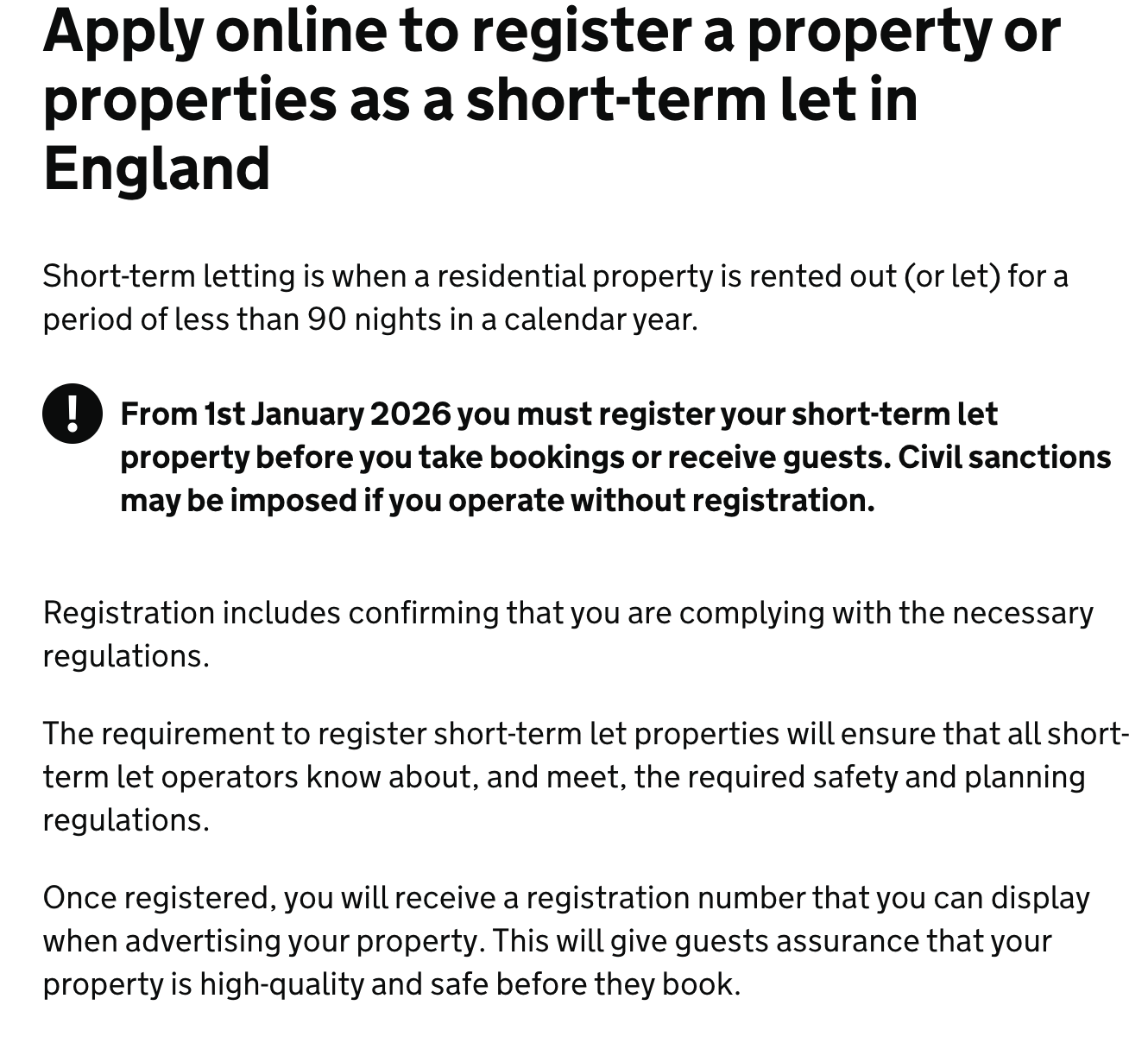
What will motivate operators to register their short-term lets?
What we tried to achieve
We were aiming to speak to people who would be actual users of this service and understand what the drivers might be that would motivate them to register their short-term lets. We wanted to understand what might have the biggest influence on them, things that would ‘push’ them to register (i.e. a fine, legal repercussions, etc.) or things that would ‘pull’ them to register (i.e. a registration number and digital badge, credibility or other benefits).
In doing this it would help us to learn more about a key assumption we had in this area:
Assumption 3 - “We assume that operators won’t register their properties unless there’s a compelling reason to do so”
How we tested our assumption: methods, validation, and rationale
Our testing approach
We primarily tested this assumption in Round 1 of our testing, where we conducted 5 usability testing sessions with different operators. The make-up of the participants for this round of testing is shown in the table below.
| Breakdown of key characteristics of Round 1 participants that tested this assumption | |
|---|---|
| Experience of operator | 1 × Own a property that could be used as a short term let but are currently not using it for this purpose 1 × Less than 12 months 1 × 1-5 years 2 × 10+ years |
| Type of short-term lets owned | 2 × Entire privately owned house(s) 1 × Privately owned self-catering holiday home(s) e.g. Holiday Cottage 1 × Individual rooms or annex within privately owned house(s) & Privately owned self-catering holiday home(s) e.g. Holiday Cottage, Self-catering Apartment, Serviced Apartment 1 × Individual rooms or annex within privately owned house(s) 1 × Entire privately owned house(s) & Self-catering Apartment |
| Number of short-term lets owned | 1 × 1 short-term let 2 × 2-5 short-term lets 1 × 5 short-term lets 1 × 10+ short-term lets |
| Number of days the short-term lets are let out over a calendar year | 1 × let for 31-90 days 3 × let for 181-365 days 1 × Own a property that could be used as a short term let but are currently not using it for this purpose |
| Location of short term lets | 1 × Northwest England 1 × Northeast England 1 × London/Greater London & Southeast 1 × Southeast England 1 London/Greater London & Southwest |
| Self managed or using a management company | 2 × self managed 1 × use a management company 1 × Part self managed & also uses a management company 1 × None of the above (prospective operator) |
| Places where participants advertise (multiple choice) | 1 × Sykes Cottages 3 × AirBnB 1 × Facebook 1 × Booking.com 2 × Vrbo UK 1 × Holiday Lettings |
| Digital literacy | 5 × 10/10 |
| Access needs | None |
| Assistive Tech used | None |
Testing sessions lasted one hour, during which participants were shown several different versions of start pages with different ‘compelling reasons’, and also an example booking platform listing page displaying a registration number and digital ‘badge’ confirming their property was a registered short-term let.
Our hypothesis around the digital ‘badge’ was that one motivator to encourage operators to register could be bookers’ perceptions of registered properties. Some kind of ‘badge’ for operators to display with their registration number on their listing would show bookers at a glance that the property is part of the registration scheme, and therefore compliant - reassuring bookers and therefore driving bookings; so a ‘badge’ could be a valuable benefit to operators.
Screenshots of these different start pages and booking platform listing pages can be seen in the ‘Design prototypes’ section.
For the start page section, we asked participants the following kinds of questions:
“Now we’d like to show you some examples of a ‘Start’ page for registering service and get your thoughts. We will share the link in the chat, if you are able to share your screen at this point that would be great.”
Participant is asked to select a version of the start page
- What are your thoughts on this?
- If you read something like this how likely would you be to start registering?
- On a scale of 0 (would never) to 5 (would register ASAP), how likely would you register after having read through this?
- What part stands out the most to you?
- Benefits/badge or warning
These questions were repeated for each version of the start screen until the participant had seen all the versions.
They were also shown two mock-ups of booking platform listing pages featuring a registration number and a draft “badge” that showed the property listing was a registered short-term let, to gauge the value of being able to display these on a property listing. We tested two versions of the badge to get feedback on how to visually display this registration information. Screenshots of these versions can be seen in the ‘Design prototypes’ section. Below is an example of the questions in the discussion guide for this.
Participant is asked to select a Listing Screens option for a platform of their choice
-
What do you think of this as an idea?
- What do you think of the ‘badge’?
-
What bearing would something like this have on whether you would register?
-
How does something like this (or your property appearing on a searchable register of registered properties) compare to the risk of being fined?
Participant is asked to select a Listing Screens Option 2 for a platform of their choice
-
How does this version of the ‘badge’ compare the one you just saw?
-
Compared to the one you just saw, would having this ‘badge’ make any difference as to whether you would register?
Revised versions of the ‘start page’ were also tested in Rounds 2 and 3 of the usability testing, as part of testing the whole journey. It should be noted that in Rounds 2 and 3 typically only one version of the start page was shown to participants in a session.
As part of our survey with Management Companies we also asked a question to try and understand what might motivate them to play a part in a registration scheme.
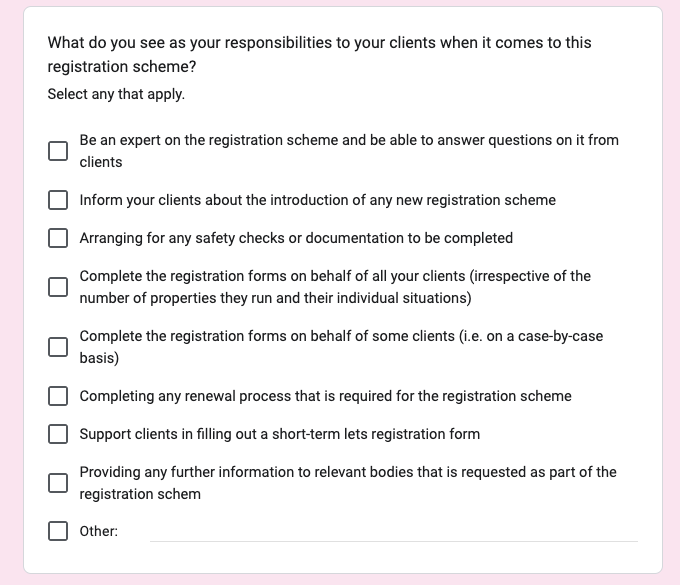
The findings from our usability testing sessions and survey of management companies can be found in the ‘Our findings’ section below.
Design prototypes
To determine what might motivate operators to register their short-term let, we prototyped three versions of a registration service start page, using both incentive (“carrot”) and deterrent (“stick”) approaches. We also mocked up booking platform listing pages displaying a registration number and digital badge.
The start pages
These included:
- Benefits of registration:
- Operators would receive a registration number and digital badge for display when advertising their property.
- Warnings about non-compliance, including:
- Threat of a fine up to £2,500 per property (note - this was only for presentation and is subject to policy development)
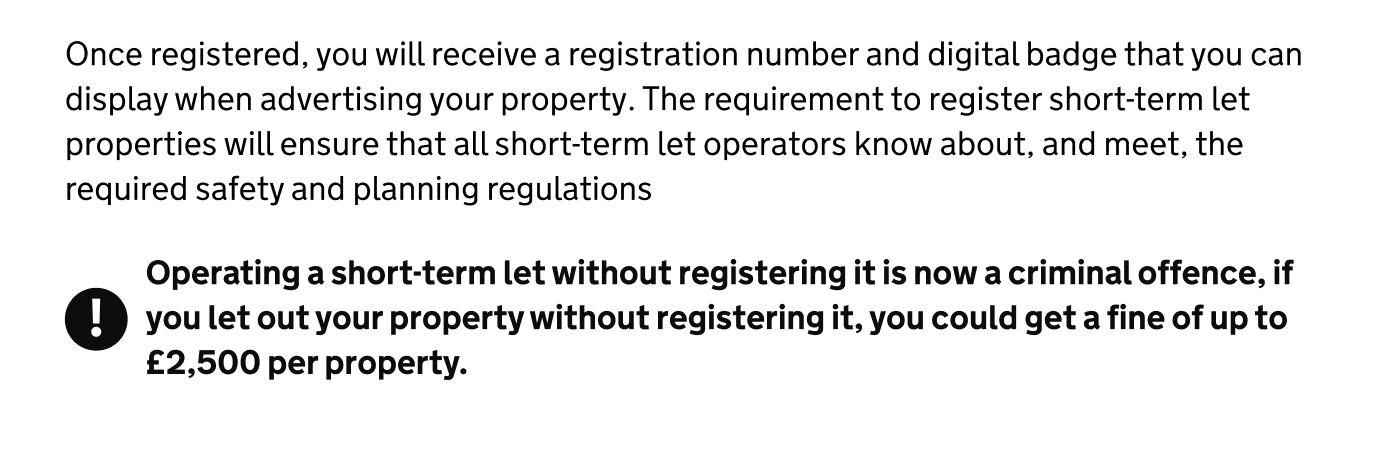
- Non-compliance classified as a civil offence. (This was initially tested using the term “criminal offence,” but after discussions with the policy team, we agreed to align the wording with the Levelling-up and Regeneration Act (LURA) which also uses “civil offence” to accurately reflect the potential warning).
- Legal requirement to register.
Original wording tested:
- Varying placement of benefits vs. warnings
- Version 1: Warning (bold with warning icon) after benefits.
- Versions 2 & 3: Warning placed before benefits.
Version 1: 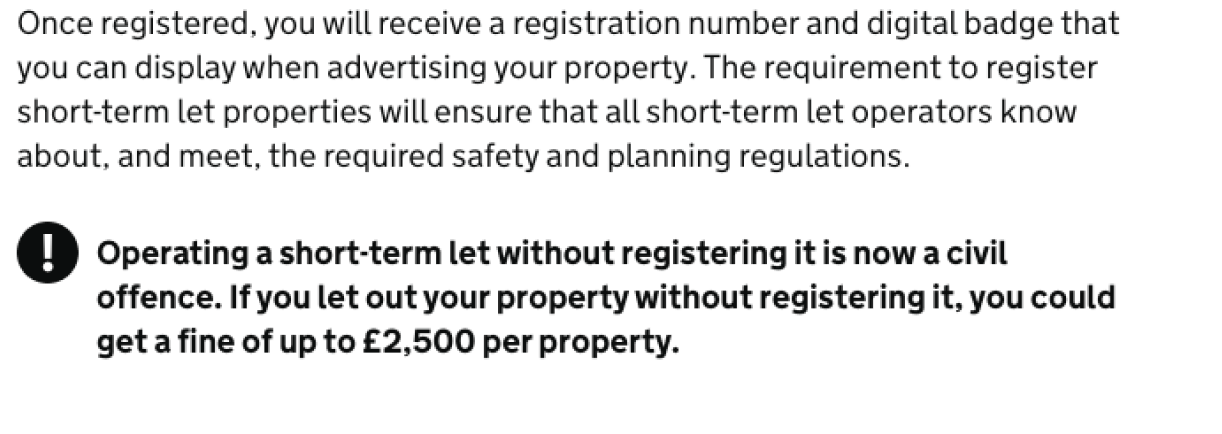
Version 2:
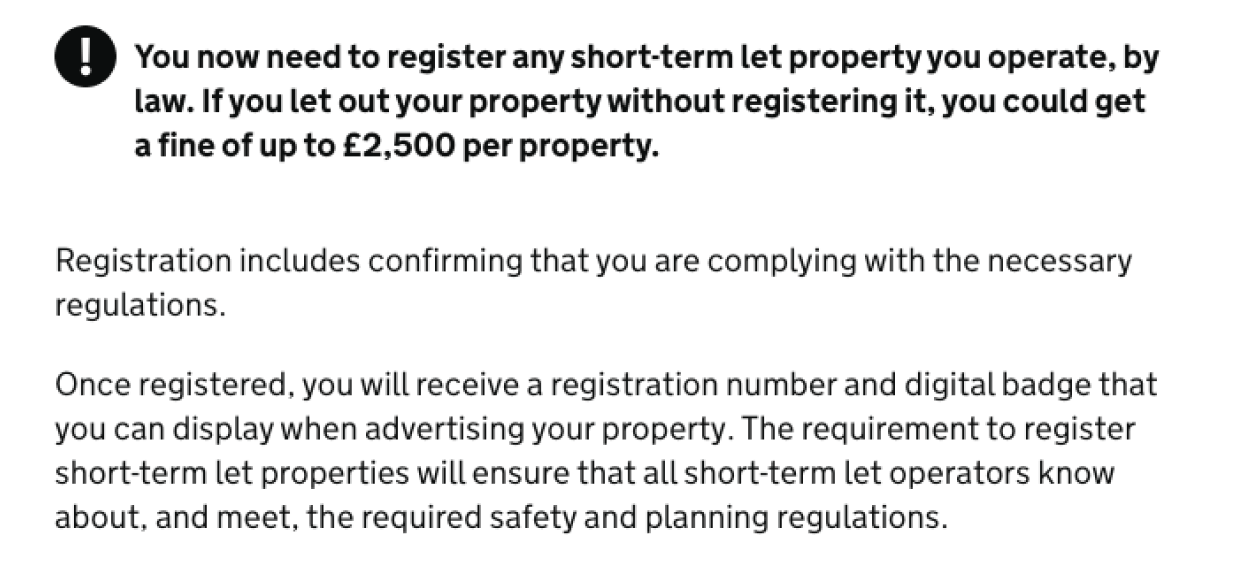
Version 3:
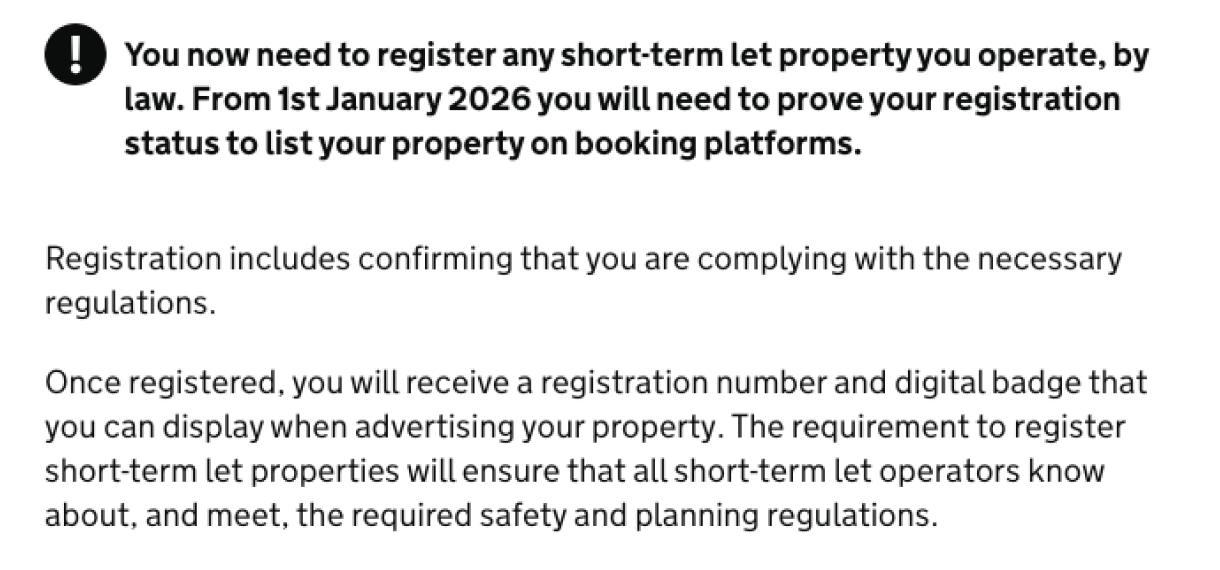
During testing sessions we had a discussion guide to prompt conversations with the participant. We were hoping to answer questions such as:
- To what extent would receiving a registration number and a digital badge influence whether a participant would choose to register their short-term let?
- To what extent would the threat of receiving a fine of up to £2,500 per property influence whether a participant would choose to register?
- To what extent would the threat of not being able to advertise their property via a booking platform influence whether a participant would choose to register?
- Did the wording ‘criminal offence’ or ‘civil offence’ have any impact on participants, or would simply saying that the registration is required by law be a reason they might register?
The booking platform listing pages
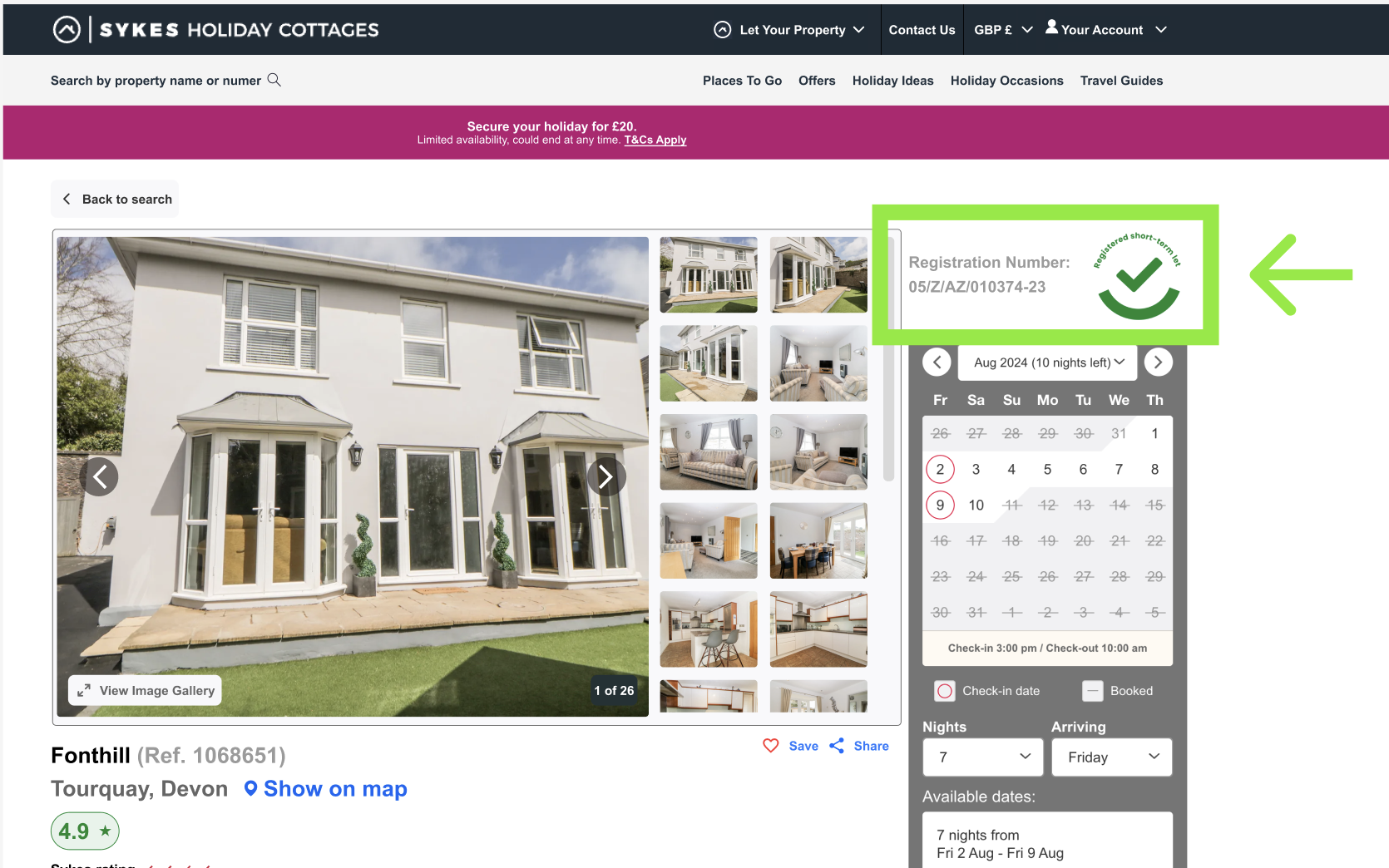
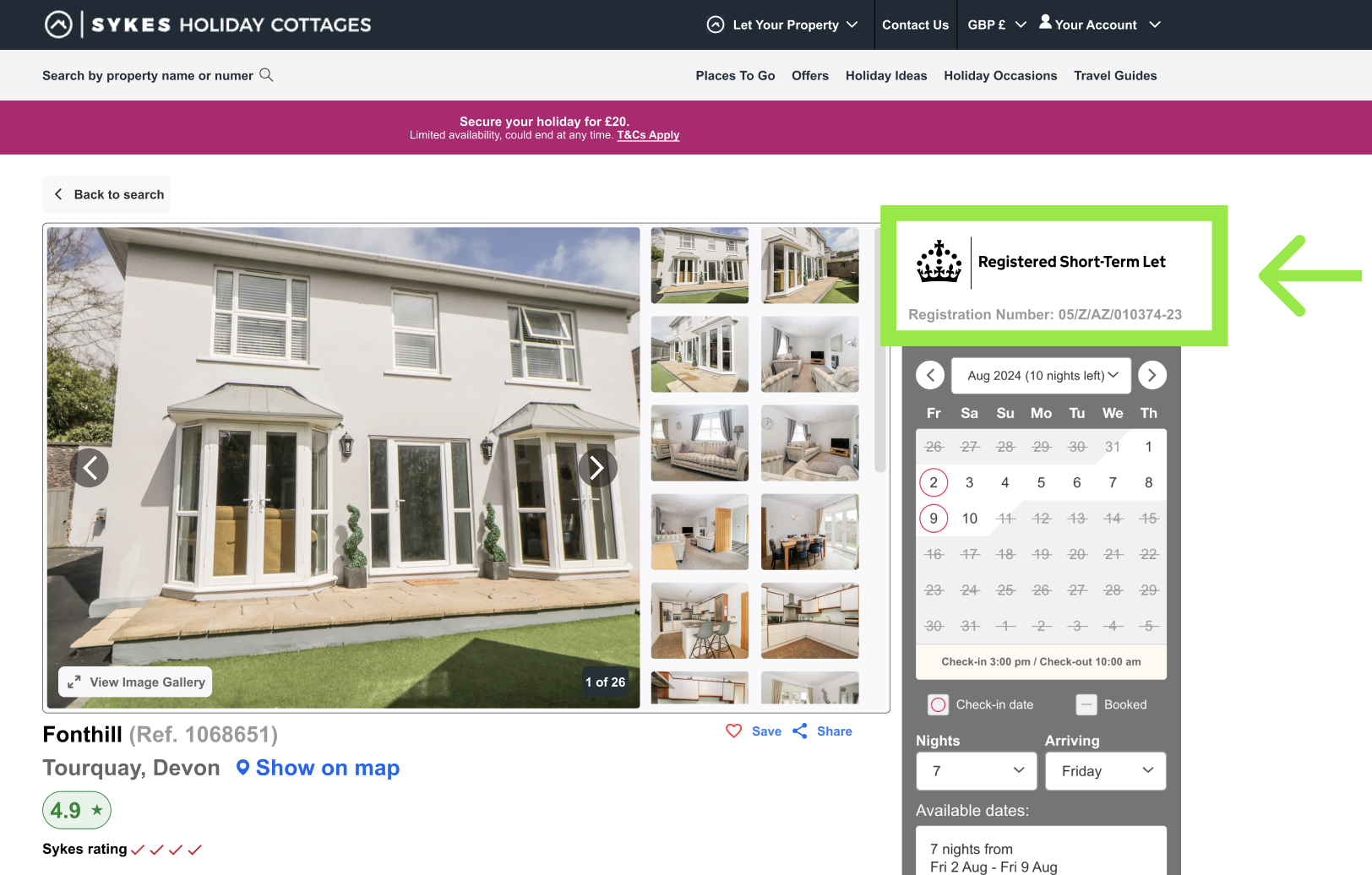
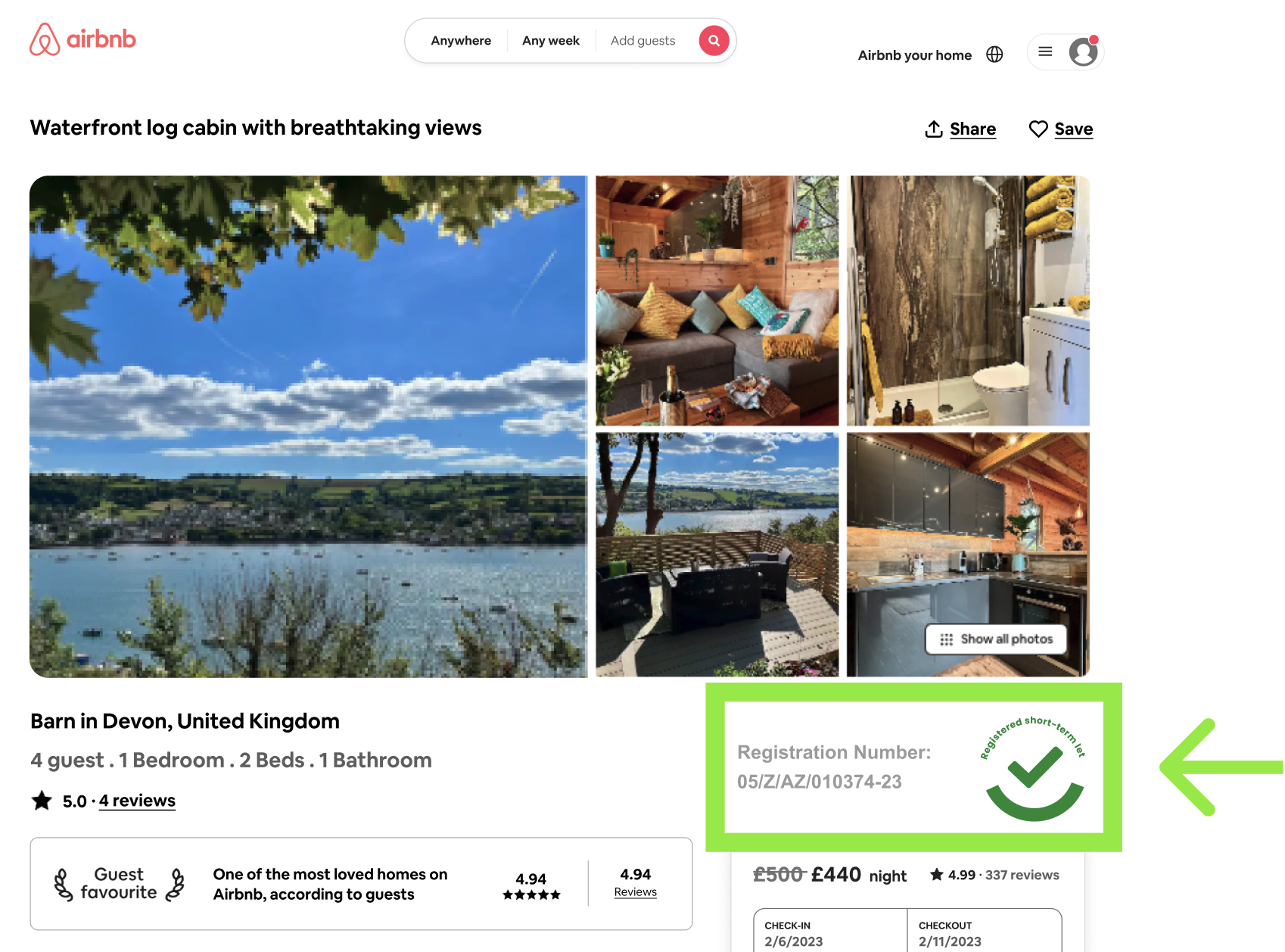
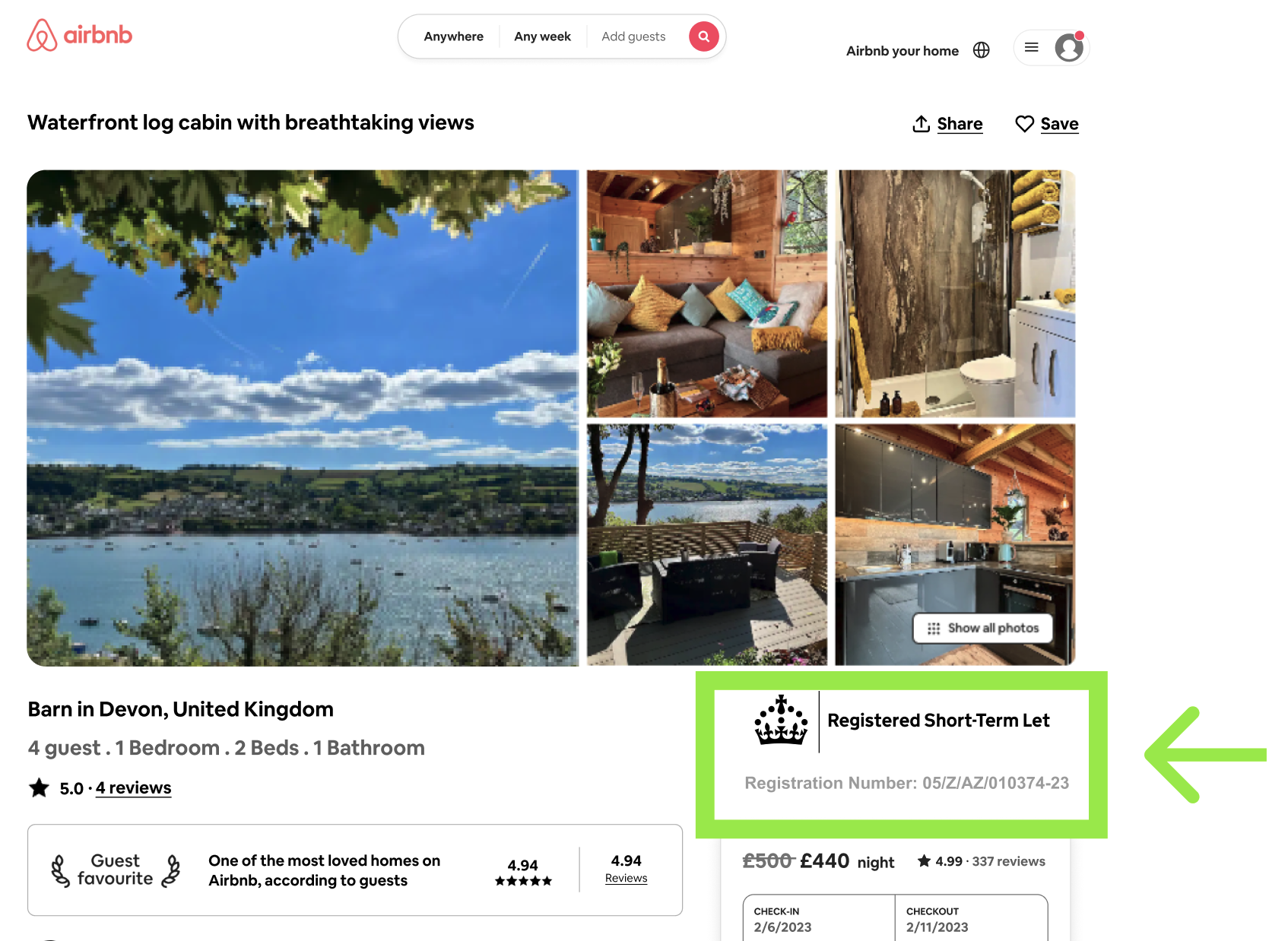
We also mocked up two booking platforms’ listing pages (Airbnb and Sykes Cottage) to visualise how a property’s registration number and badge could be displayed after successful registration.
These two platforms were chosen because Airbnb is a major platform for short-term lets, and Sykes Cottages is a leading independent holiday cottage agency in the UK, hopefully making them both recognisable to participants when in user testing sessions. When recruiting participants we captured information on which booking platforms they used to advertise their property. We used this information to ensure we only created mock ups for booking platforms which were actually used by our participants. During the testing sessions participants were asked to select a version for a booking platform which they were most comfortable with, and then we subsequently tested with that version.
We tested two versions of the registration number and badge design:
- A ‘tick’ badge inspired by VisitEngland’s “We’re Good to Go” badge: this badge was created for their “Good to Go” scheme introduced during Covid (where businesses that were Covid-safe were able to add the badge to their listing to reassure customers that the premises was safe).
- A GOV.UK Crown style badge: a more obviously government-branded version of the badge, to show that the operator had registered with a government scheme.
These were tested in two different locations on the two platform listing pages, to gauge noticeability as well as design preference. Technical feasibility of badge addition and location on the platforms’ pages was not explored at this early stage; the focus was solely on gathering users’ feedback on the value and visibility of the badge.
Platform 1 listing pages (Sykes Cottages):
Platform 2 listing pages (Airbnb):
Our findings
Findings from usability testing sessions with operators
Our usability testing sessions in Round 1 gave us several interesting insights on what might motivate operators to register for the short-term lets registration scheme.
Round 1 findings and resulting decisions
1. Operators don’t need to be threatened into registering as many want to do the right thing, this may be enough of a ‘compelling reason’
We learnt from our testing that an operator does not necessarily need to be ‘pushed’ or ‘pulled’ to register, and in fact most are looking to comply because it is the right thing to do. It should be noted that the reason people think it ‘is the right thing to do’ can vary. That feeling is very personal to them. It might be because of their political persuasion, their morals, or other personal beliefs, their financial situation, or their specific situation as a short-term let operator.
“It makes sense. Being in the business I don’t love it (but) it doesn’t seem unfair.”
“health and safety, well that’s noble, you do see the whole slumlord properties”
There were numerous comments about how the language used came across as threatening, or was hostile and aggressive. This seems to jar with participants who wanted to do the right thing. It caused negative reactions such as anxiety and fear amongst our participants.
“It’s (the start page) a bit brutal”
“This (start) page causes nothing but sadness. (The) warning is the icing on the cake of making your heart jump”
“It’s quite aggressive especially when people are on this page to not commit an offence”
“That (warning text) is quite aggressive. It makes sense, but it’s quite aggressive”
This willingness to ‘do the right thing’ was not a universal opinion though, as there was an instance of an operator stating that they would not comply until they are forced to do so.
Resulting service/prototype design suggestions for consideration in subsequent design work:
- Can we make the experience more ‘personal’, or provide people registering with more details that are specific to their own individual circumstances?
- Can the language be softened to make is less hostile and aggressive
2. Not being able to use platforms acts as a push for more experienced hosts or those that use it as a primary income
When comparing the different ‘push’ and ‘pull’ techniques used across the prototypes, the threat of not being able to list a property on booking platforms had the biggest impact on operators. This was particularly true for more experienced operators or those that rely on short-term let income for their primary income. These participants were able to understand the financial impacts of not being able to list on a booking platform. By contrast, the one ‘Prospective short-term let operator’ that we tested this hypothesis with was not able to see these impacts, and did not see the threat of not being able to list on a booking platform.
“(not being able to use booking platforms is a) huge threatening point”
“will it (not being able to use a platform) affect bookings for the next year?”
The language used was once again an issue here, with participants expressing that it felt too harsh.
Resulting prototype design suggestions for consideration in subsequent design work:
- Keep the ‘threat’ of not being able to list a property on booking platforms on the start page as a means of ‘pushing’ operators to register. But look to soften the language i.e. “operators who willfully decide not to register may not be able to list their short-term lets booking platforms”
3. When reading about the ‘digital badge’ on the start page, the badge itself and its benefits are not immediately understood, however upon seeing an example on the mocked-up listing page it is more understandable
When interacting with the different start pages our participants in the main struggled to engage with the idea of the digital badge. Some people missed the references to it entirely, and some misinterpreted its purpose or how it might work. There was only one participant who could visualise the positive impact on them as a short-term let operator.
“at this point (reading start page) I’ve heard nothing that would add value”
This was in contrast to when participants saw the badge on the listing page prototypes. Here all participants were able to understand what the badge was. However, the perceived benefit of it varied considerably. Some could see how it was a perk of registering, or visualise how it might increase their likelihood to register to a smaller extent. But no-one saw it as a driving factor to register. Additionally, if a participant had begun to develop a negative perception of the registration scheme - for example once they read about the risk of a fine, or a sanction, or being unable to list on booking platforms - the concept of the badge was not able to alter their opinion in any way.
“I would be more inclined to register (because) it’s a positive thing (to have on your listing). If I think as a (prospective) booker, if they were looking at 2 different properties and 1 was registered STL, they’d go for this one with reg STL.”
“If that’s the ‘benefit’ [the badge], that carrot is the tiniest little baby carrot that’s just growing vs a massive massive club”
With regards to the appearance of the badge itself there was no outright ‘winner’ when it came to the crown or the tick design. Each was equally liked/disliked by our participants.
Resulting prototype design suggestions for consideration in subsequent design work:
- Explore how to better communicate the badge itself and its benefits. Perhaps highlight its benefits on the start page as prominently as the repercussions (i.e. the fine, the threat of not being able to list on booking platforms, etc.)
- Better articulate on the ‘start’ page how the badge appears on a booking platform listings page
4. Operators might be more compelled to register if there were a more tangible commercial benefit
As part of the session operators were asked what benefits they might expect to get when registering for such a scheme. Participants did not cite the digital badge, instead they thought more about how they might benefit from a marketing perspective, or through gaining a ‘better quality of guest’. An example of an expected benefit of registering was the ability to be able to connect with equivalent registered guests, perhaps through some sort of ‘online portal’ that was only available to registered operators.
“utopia would be the tenants signing up too, you (operators) could only get a 4/5 star tenant!”
Resulting service design suggestions for consideration in subsequent design work:
- Investigate with booking platforms the feasibility of other benefits that operators have suggested, for example:
- The ability for bookers to filter by ‘registered’ on booking platforms
- Introducing an ‘are you sure you want to stay here?’ type alert/modal as bookers try to book on an unregistered short-term let
- ‘Promote’ registered short-term lets on booking platforms’ results pages
- Investigate whether it would be possible for the service to offer wider benefits to operators who register, to increase their motivation to register, for example:
- One participant stated that it would be a benefit if their insurance premiums could be lower as a result of registering and providing their registration number to their insurer.
- However it should be noted that many of these types of ideas may be outside the sphere of influence of the registration scheme.
5. Personal credibility, and to a lesser extent improving the credibility of the sector, is somewhat of a pull to register
Operators also saw some benefits to their reputation of registering for such a scheme. There was an understanding that by registering it would make it more apparent who is reputable within the sector, and also that registration would also improve the standards in the sector.
“I like it cos you can register then people know you’re qualified”
“(I’m) all for raising the bar and looking for solutions and ways of doing that”
Resulting service/prototype design suggestions for consideration in subsequent design work:
- Promote the benefits of the digital badge more, and link this to how it might provide credibility to operators
- Explore other ways of recognising registered short-term lets on booking platforms (aside from a badge), for example on a property’s individual listing page or on an operator’s ‘profile’ page on booking platforms
Round 2 findings and resulting decisions
In Round 2 testing we were able to continue testing Assumption 3 (“We assume that operators won’t register their properties unless there’s a compelling reason to do so”) and gained further insights:
1. The fact registration is mandatory is seen as a compelling reason to register
When both rounds of testing were reviewed together, the biggest reason why people felt they would register was because they had read that it was a legal requirement; this was something that was referenced by 4 participants across the 10 sessions. Even though that was the most common reason, it should be noted that there is not one compelling reason that will work for all types of operators.
Resulting prototype design suggestions for consideration in subsequent design work:
- Design and test a revised start page which incorporates the ‘compelling reasons’ which were most emotive, such as:
- That fact that it is the law
- That operators not be able to list their short-term let on booking platforms
- That operators may be fined
Findings from survey of Management Companies
1. Aside from it being a legal requirement, reputation would be the driving factor that would motivate management companies to register on a client’s behalf
Responses to the survey suggest that reputation is what would compel management companies to be part of a registration scheme. The logic of the survey led to only 10 respondents answering this question. Below are the top scoring factors:
- The fact that it would be a legal requirement for your client’s short-term let to be registered (10/10)
- The reputation of your business (9/10)
- The ability to use a ‘digital badge’ and/or registration number on booking platforms for registered properties (8/10)
- The reputation of your client’s short-term let (7/10)
- If they paid you to do it as a ‘service’ (7/10)
- Their digital skills (5/10)
No other options scored more than 5/10.
From this we can see that reputation was seen as a quite large factor - both the reputation of their business, and of the client’s property, as this by association has an impact on their reputation. One respondent commented in the free text responses that;
“It (being registered) shows a standard of holiday letting which is reflective of our business and the property.”
2. Management Companies can see the benefit of a digital badge, and for them it was more a compelling reason to register than for operators.
As can be seen from the previous finding, the digital badge was the third biggest factor that might impact whether a Management Company would register a short-term let on a client’s behalf. This indicates that they might see that as more of a compelling reason to register their client’s short-term lets compared to operators. In the free text responses one participant stated that;
“This (digital badge) provides a tangible benefit for clients. Displaying proof of registration can enhance their credibility, attract more bookings, and potentially command higher rental rates.”
From this we can speculate that because Management Companies are likely more commercially driven than the average operator, they therefore understand how displaying a badge as proof of registration might drive more bookings.
What happened next
- After discussing the ‘warning’ language on the start page with the DCMS Policy and Legal teams, we developed version 1 by changing “criminal offence” to “civil sanctions”, as this most accurately conveyed the type of offence that the Levelling Up and Regeneration Act indicates would be given. We also softened the rest of the language, with the aim of landing the message better with operators; and used this version in subsequent rounds of testing of the start page.
- We explored ways to make the communication of the scheme’s benefits on the start page more tangible and commercially appealing
- We tested and iterated the content and design of the start page to find the right balance of motivation and information
Following multiple research sessions, consultations with DCMS Policy and Legal teams, and user feedback, here is the iterated version of the start page we’re taking into Beta for further exploration and testing. It features the revised “civil sanctions” wording, softer language overall, and a clearer focus on the scheme’s benefits.